
Messier 5 - The Rose Cluster
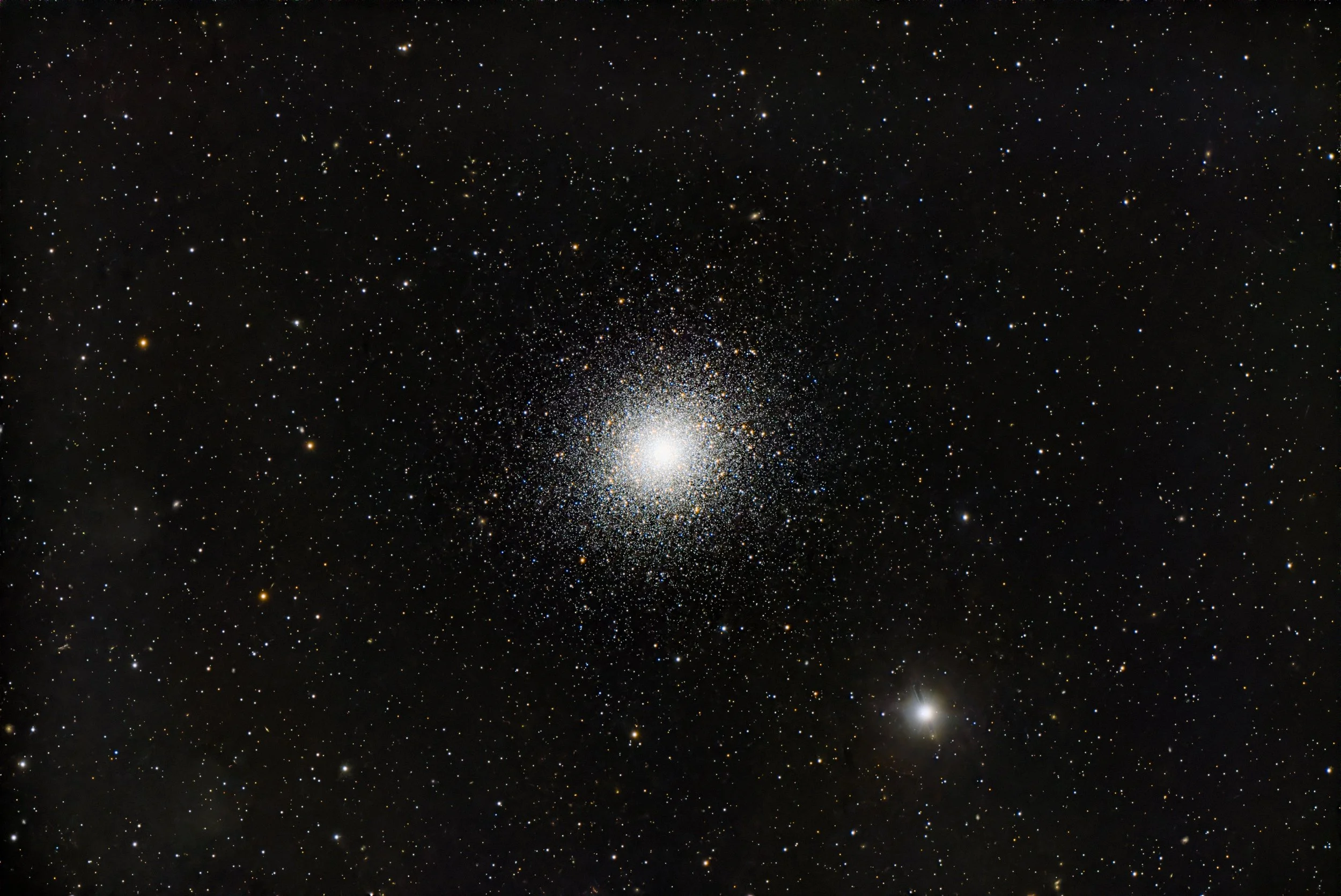
Acquisition Details
Date: 2026/05/10
Exposure: 53 × 120” (~1.8 hours)
Bortle Scale: 6
Gear: ZWO ASI2600MC Duo, Askar 130PHQ, Sky Watcher EQ6-R Pro, ZWO ASIAIR Plus, ZWO EAF
Discovered: May 5, 1702 by the German astronomer Gottfried Kirch [1], Independently rediscovered on May 23, 1764 by Charles Messier. [2]
Object Type: Globular Cluster [1]
Apparent Magnitude: 6.7 [1]
Distance: 25,000 light-years away [1]
Other Designations: NGC 5904, CGI 34, Mel 133 [3]
Constellation: Serpens [1]
Notes from Messier:
May 23, 1764. 5. 15h 06m 36s (226d 39' 04") +2d 57' 16"
Beautiful Nebula discovered between the Balance [Libra] & the Serpent [Serpens], near the star in the Serpent, of 6th magnitude, which is the 5th according to the Catalog of Flamsteed [5 Ser]: it doesn't contain any star; it is round, & one sees it very well, in a fine [clear dark] sky, with an ordinary refractor of 1-foot [FL]. M. Messier has reported it in the chart of the comet of 1763. Mem. Acad for the year 1774, page 40. Reviewed on Sep. 5, 1780, January 30 & March 22, 1781. (Diam. 3') [2]
[Mem. Acad. for 1771, p. 437 (first Messier catalog)]
The night of May 23 to 24, 1764, I have discovered a beautiful nebula in the constellation of Serpens, near the star of sixth magnitude; the fifth according to the catalog of Flamsteed. That nebula doesn't contain any star; it is round, & could have a diameter of 3 arc minutes; one can see it very well, under a good sky, with an ordinary [non-achromatic] refractor of one foot [FL]. I have observed that nebula in the Meridian, & I have compared it to the star Alpha Serpentis. Its position was right ascansion 226d 39' 4", & its declination 2d 57' 16" north. On March 11, 1769, at about four o'clock in the morning, I have reviewed that nebula with a good Gregorian telescope of 30 pouces, which magnified 104 times, & I have ensured that it doesn't contain any star.
[p. 454] 1764.May.23. RA: 226.39. 4, Dec: 2.57.16.B, Diam: 0. 3. Beautiful nebula without stars, between the Serpent ∓ the Ballance near the star of 6th magnitude, the fifth of the Serpent, according to Flamsteed. [2]
References:
[1] NASA (2026, March 20). Messier 5. Messier 5. Retrieved May 30, 2026, from https://science.nasa.gov/mission/hubble/science/explore-the-night-sky/hubble-messier-catalog/messier-5/
[2] Students for the Exploration and Development of Space (2025, February 2). Messier 5, Observations and Descriptions. Charles Messier's Catalog of Nebulae and Star Clusters. Retrieved May 30, 2026, from http://www.messier.seds.org/Mdes/dm005.html
[3] Messier 5. In Wikipedia, The Free Encyclopedia. Retrieved 04:49, May 31, 2026, from https://en.wikipedia.org/w/index.php?title=Messier_5&oldid=1347232998