
Messier 44 - The Beehive Cluster
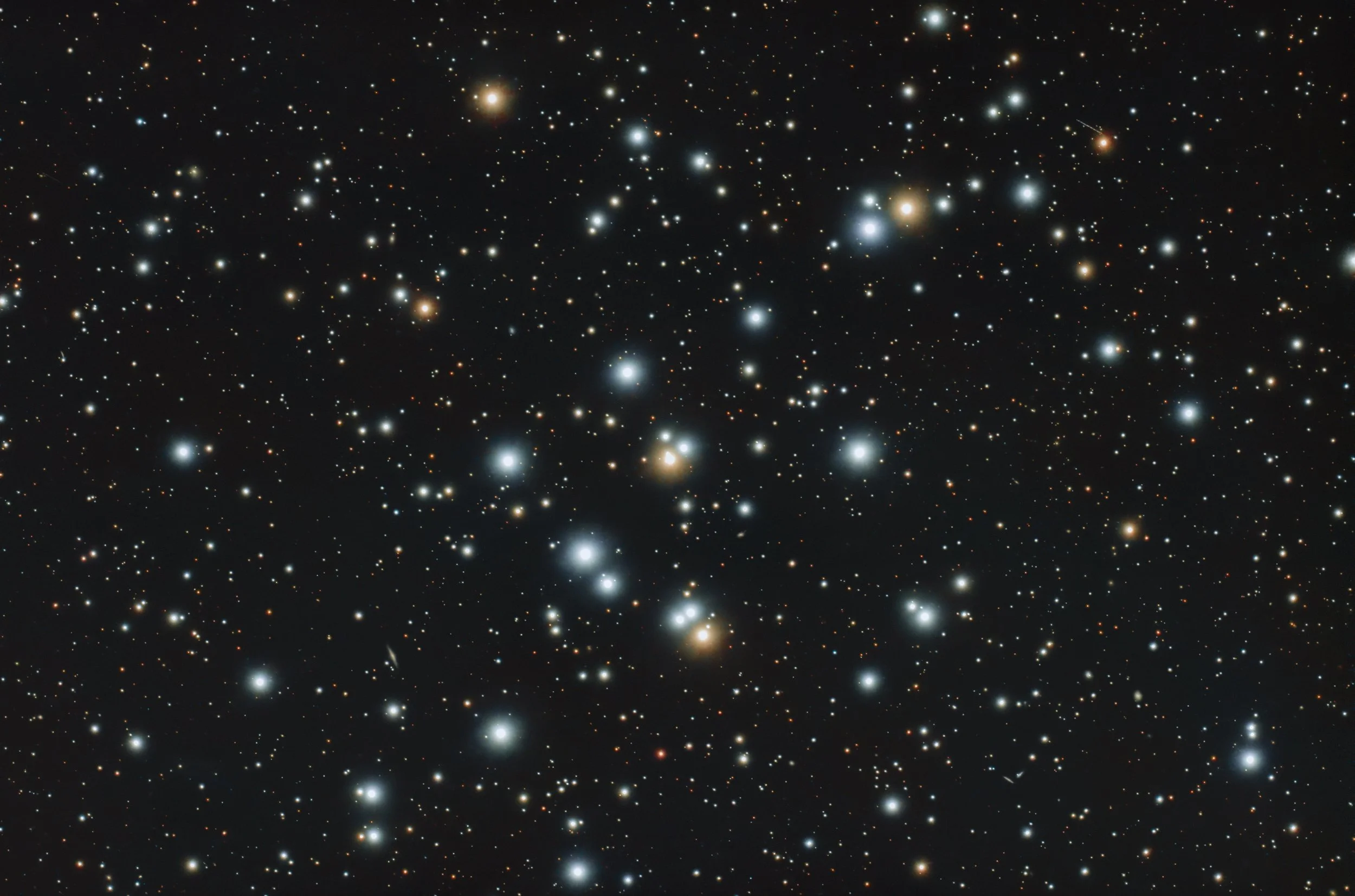
Acquisition Details
Date: 2026/01/15
Exposure: 160 × 60” (~2.7 hours)
Bortle Scale: 6
Gear: ZWO ASI2600MC Duo, Askar 130PHQ, Sky Watcher EQ6-R Pro, ZWO ASIAIR Plus, ZWO EAF
Discovered: Known to Greek Poet Aratos in 260 B.C. and observed by Greek Astronomer Hipparchus in 130 B.C., Observed and cataloged on March 4, 1769 by French Astronomer Charles Messier. [1] [2]
Object Type: Open Cluster [3]
Apparent Magnitude: 3.7 [3]
Distance: ~600 light-years away [3]
Other Designations: NGC 2632, Mel 88, Cr 189, Praesepe [4]
Constellation: Cancer [3]
Notes from Messier:
March 4, 1769. 44. 8h 07m 22s (126d 50' 30") +20d 31' 38"
Cluster of stars known by the name of the nebula in Cancer. The position given is that of the star C. [2]
[Mem. Acad. for 1771, p. 451-452 (first Messier catalog)]
At simple view [with the naked eye], one sees in Cancer a considerable nebulosity: this is nothing but a cluster of many stars which one distinguishes very well with the help of telescopes, & these stars are mixed up at simple view [to the unaided eye] because of their great proximity. The position in right ascension of one of the stars, which Flamsteed has designated with the letter c, reduced to March 4, 1769, should be 126d 50' 30", for its right ascension, & 20d 31' 38" for its northern declination. This position is deduced from that which Flamsteed has given in his catalog.
[p. 458] 1769.Mar. 4. RA: 126.50.30, Dec: 20.31.38.B. Cluster of stars known by the name of the nebula of Cancer: the position reported is that of the star c. [2]
References:
[1] Students for the Exploration and Development of Space (2007, August 25). Messier 44. Charles Messier's Catalog of Nebulae and Star Clusters. Retrieved May 31, 2026, from http://messier.seds.org/m/m044.html
[2] Students for the Exploration and Development of Space (2025, February 2). Messier 44, Observations and Descriptions. Charles Messier's Catalog of Nebulae and Star Clusters. Retrieved May 31, 2026, from http://www.messier.seds.org/Mdes/dm044.html
[3] NASA (2026, March 27). Messier 44. Messier 44. Retrieved May 31, 2026, from https://science.nasa.gov/mission/hubble/science/explore-the-night-sky/hubble-messier-catalog/messier-44/
[4] Stellarium (n.d.). Messier 44. Stellarium Web. Retrieved May 31, 2026, from https://stellarium-web.org/