
Messier 33 - The Triangulum Galaxy
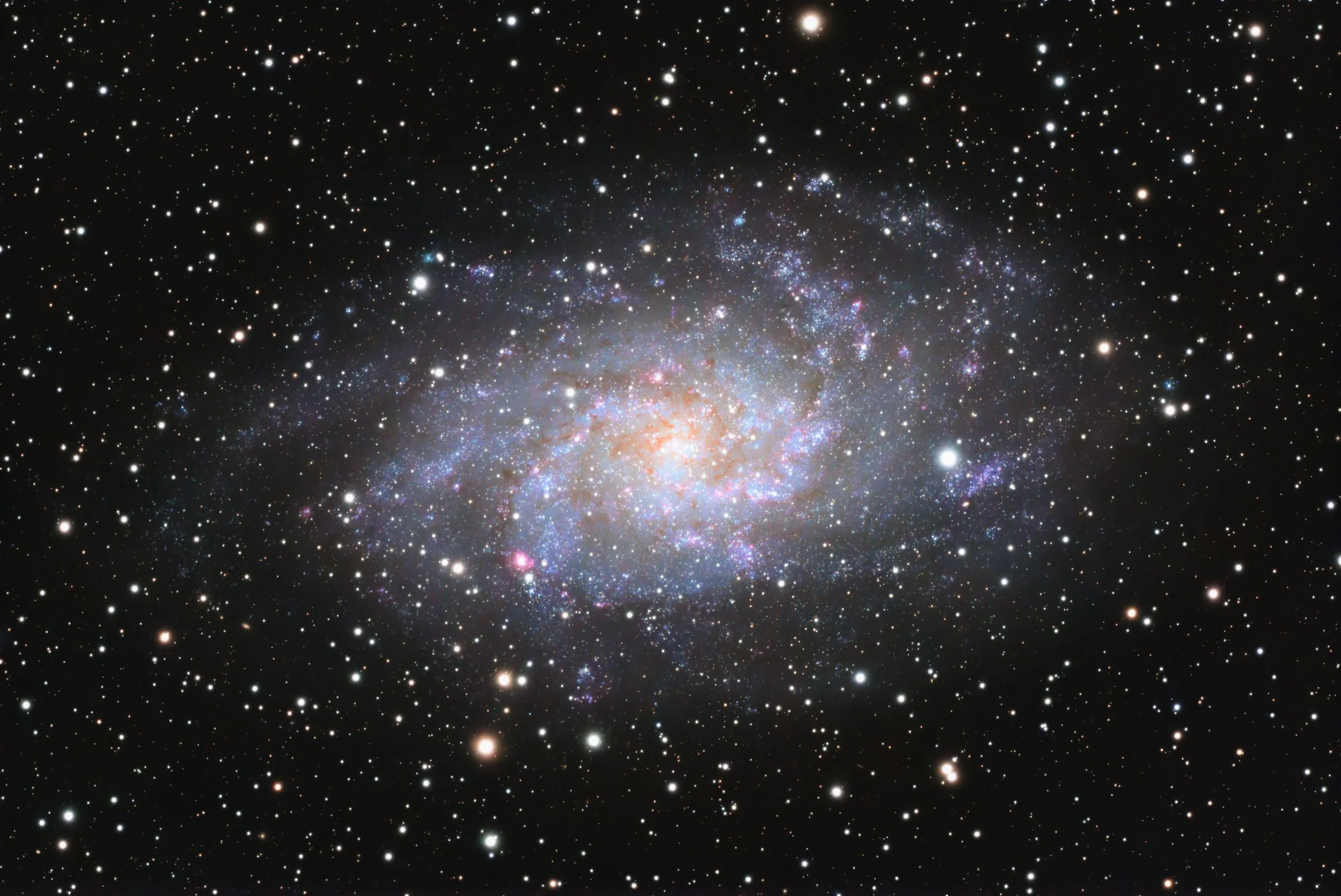
Acquisition Details
Date: 2025/12/13
Exposure: 150 × 60” (2.5 hours)
Bortle Scale: 6
Gear: ZWO ASI2600MC Duo, Askar 130PHQ, Sky Watcher EQ6-R Pro, ZWO ASIAIR Plus, ZWO EAF
Discovered: Possibly 1654 by the Italian astronomer Giovanni Battista Hodierna, Observed and cataloged on August 25, 1764 by French Astronomer Charles Messier. [1][2]
Object Type: Spiral Galaxy [3]
Apparent Magnitude: 5.7 [3]
Distance: ~3 million light-years away [3]
Other Designations: NGC 598, UGC 1117, PGC 5818 [4]
Constellation: Triangulum [3]
Notes from Messier:
August 25, 1764. 33. 1h 40m 37s (20d 09' 17") +29d 32' 25"
Nebula discovered between the head of the Northern Fish [of Pisces] & the great Triangle, a bit distant from a star of 6th magnitude: The nebula is of a whitish light of almost even density [of brightness], however a little brighter along two-third of its diameter, & contains no star. One sees it with difficulty with an ordinary telescope of 1-foot [FL]. Its position was determined from Alpha Trianguli. Seen again September 27, 1780. (diam. 15') [2]
[Mem. Acad. for 1771, p. 448 (first Messier catalog)]
In the night of August 25 to 26, 1764, I have discovered a nebula between the head of the northern Fish [of Pisces] & the large Triangle [Triangulum], a bit distant from a star whioch had not been known, of sixth magnitude, of which I have determined the position; the right ascension of that star was 22d 7' 13", & its declination 29d 54' 10" north: near that star, there is another one which is the first of Triangulum, described by the letter b. Flamsteed described it in his catalog, of sixth magnitude; it is less beautiful than that of which I have given the position, & one should set it to the rank of the stars of the eighth class [magnitude]. The nebula is a whitish light of 15 minutes in diameter, of an almost even density, despite a bit more luminous at two third of its diameter; it doesn't contain any star: one sees it with difficulty with an ordinary [non-achromatic] refractor of one foot [FL]. I have compared it to the star Alpha Trianguli, & with that of which I have reported the position. I have found the right ascension of that nebula at 20d 9' 17", & its declination of 29d 32' 25" north. [p. 457] 1764.Aug.25. RA: 20. 9.17, Dec: 29.32.25.B, Diam: 0.15. Nebula without stars, between the head of the northern Fish [of Pisces] & the great Triangle, it has little distance from a new star of 6th magnitude & the star b Trianguli, according to Flamsteed. [2]
References:
[1] Students for the Exploration and Development of Space (2024, January 6). Messier 33. Charles Messier's Catalog of Nebulae and Star Clusters. Retrieved May 31, 2026, from http://www.messier.seds.org/m/m033.html
[2] Students for the Exploration and Development of Space (2005, March 25). Messier 33, Observations and Descriptions. Charles Messier's Catalog of Nebulae and Star Clusters. Retrieved May 31, 2026, from http://www.messier.seds.org/Mdes/dm033.html
[3] NASA (2026, February 19). Messier 33. Messier 33. Retrieved May 31, 2026, from https://science.nasa.gov/mission/hubble/science/explore-the-night-sky/hubble-messier-catalog/messier-33/
[4] Stellarium (n.d.). Messier 33. Stellarium Web. Retrieved May 31, 2026, from https://stellarium-web.org/